
人文地理学ってどんな学問なの?
今や歴史総合や、公共と並んで、高校の社会科系の必修科目に君臨している「地理総合」。必修化のおかげで、知名度だけでいうと「地理」は社会学や心理学、文化人類学などに比べてはるかに高く、大いに得をしているといえるかも知れません。にもかかわらず(いや、そのせいでと言ったほうがいいかも知れませんが)、恐らく地理学ほど、皆さんから誤解されている学問もそうはないでしょう。
皆さんが、どの大学で地理学の講義を履修しても、その大学の地理学者はほぼ間違いなく、ため息交じりにこう呟くはず。曰く「高校地理と大学の地理学は違います」と。受験の際に誰もが必修科目として学んできたにもかかわらず、大学でまず高校地理と大学の地理学の違いについて話すところから授業を始めなければいけない、それだけ皆さんの「地理」イメージは強固で、その多くは教える側にとってはむしろありがた迷惑な誤解を含んでいるのです。
地理学は、その定義だけいうと非常にシンプルです。何しろ学問としての制約はたった一つ、扱う対象が「地表上に広がる空間的事象」であることしかありません。地表上に広がりをもつ現象であればいいのですから、世の中のほとんどの自然現象(気候や地形、土壌や植生の成り立ち)はほぼ地理学で扱うことができます。自然現象のほとんどは、人がいてもいなくても起こりますよね?これら、人の存在とかかわりなく起こる事象を扱うのが、地理学の半分を占める「自然地理学」です。
でも、自然地理学の題材である熱帯低気圧は、人の存在に関係なく発生する自然地理学の研究対象ですが、それが台風になったとたん災害という形で人に影響をもたらしますよね?こうなると、どうすればそのリスクを減らせるかを考えることになり、地理学のもう半分を構成する「人文地理学」の守備範囲に入ってくることになります。地理学のなかには自然と人文の2つの地理学があり、私の所属している人文地理学教室は、この人文地理学を教えているところです。
人文地理学も自然地理学と同じく、対象の制約は「地表上に広がる空間的事象」だけ。なので、皆さんの良く知る農作物生産の地域的な違い(農村地理学)であっても、交易を通じた物やお金の動き(商業地理学、経済地理学)であっても良く、人の空間的行動やそれを引き起こすある場所へのイメージ(行動地理学)すらも研究対象にできます。こうした対象の制約からの自由さや守備範囲の広さは、地理学のひとつの魅力といえるかも知れません。
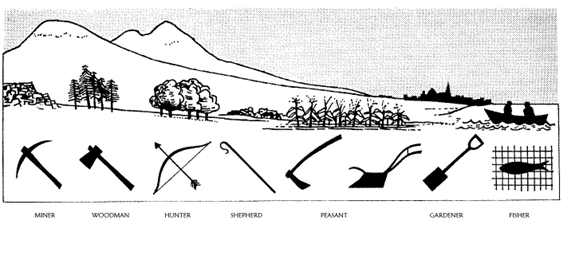
私が大学で地理学について語るときしばしば引用するのが、1909年に描かれたこの『谷のセクション』という題の模式図です。実はこれ、描いたのはパトリック・ゲデスという都市計画家でありながら、地理学という学問の考え方をとても上手に表現しているのですね。
この図が描写しようとしているのは、山から海に至るまでの自然条件の変化を断面図にしてみたときの、人の暮らしぶりや社会の営みの多様さです。人間は長い時間を掛けて知識を増やし、技術を発展させて自然に抗う術を少しずつ身に着けてきました。それでもひとたび自然災害が起これば、容赦なくそれまでの人々の暮らしは破壊されてしまいます。与えられた自然条件を変えられない以上、いかにそのリスクを最小化し、自分たちが生き残る可能性を最大化しながら生き抜いていくか。これが今に至るまで、人類の一番大きな課題だったといっても過言ではないでしょう。ゲデスの図に描かれた暮らしぶりの多様性が意味しているものは何か?それは、目の前の何気ない暮らしぶりは、それぞれの地域に住む人々が、何世代にもわたる自然とのせめぎあいの中で各々の最適解を考えてきた結果としてそこに現れたものなのだということです。
山岳地帯という、所与の条件下にいる人間がいくら釣り糸を垂れ、投網を放っても、恐らく釣果はほとんどないでしょう。食料が確保できない以上、彼らは滅びるしかありません。つまり山岳地帯では、樹木に囲まれた自然条件に合致する技術(斧やノコギリ)を生み出し、住宅の建材に樹木を利活用する文化を創造できた人々だけが、生き抜くことを許されるということです。川や海辺でもそう。斧やノコギリをいくら水面に投げ込んでも魚は採れない。森林に生きる人々の最適解が、海辺に生きる人の最適解とは限らないのです。
私たちが生きているこの世界は、驚くほど豊かな多様性を有しています。結果として目の前に広がっているその多様性は、人間がそれぞれの自然条件の下で、必死に生き抜いてきた過程(プロセス)の帰結として、いま目の前に存在している。そのユニークさを捉え、そのユニークさを形作ってきたメカニズムやプロセスを解明すること、これが大学で皆さんが学ぶ「地理学」という学問の本質だと私は考えています。
皆さんは、高校までの「地理」を、最終的に入試でいい点を取るために勉強してきたはずです。でも考えてみてください。皆さんにはテストそのものに対して、「選択肢には必ず、あらかじめ1つの正解と複数の不正解が用意されているはず」という揺るぎない信頼感をもって受験したでしょう?皆さんはただ、誰かが作った正解を覚え、覚えた知識のあやふやさを試すために誰かが作ったひっかけ問題に惑わされず、正解を選び出すことさえできれば良いと、そう確信していたはずです。言い換えるなら、皆さんが受験でやってきたことは、人が作った知識を消費する行為。だから、皆さんは作問者や出題者に「受験料」を納め、教科書を作った誰かさんに「書籍代」を払うのです。
大学で皆さんが学ぶのは、そうした知的消費としての「地理」ではありません。まだ誰も正解を知らない「結果としての現象」を新たに見つけ出し、その現象がなぜ、どういうプロセスを経て生まれたのかについての、新しい正解を創造する行為としての「地理学」です。
どんな些末なことであっても構わない。この世の中の「地表上に広がる空間的事象」に新たな正解を与えるための力を養う、それが人文地理学教室で皆さんが学ぼうとしていることです。
What is Human Geography?
Today, "Comprehensive Geography" stands as one of the mandatory subjects in high school social studies, alongside History and Public Studies. Thanks to its compulsory status, the subject of "Geography" has gained much more recognition compared to subjects like Sociology, Psychology, and Cultural Anthropology. In that sense, it can be said that Geography has certainly benefited in terms of visibility. However, despite this (or perhaps because of it), Geography is one of the most misunderstood fields of study by beginning students.
No matter which university you attend to study Geography, the university’s geographers will almost certainly sigh and say, “High school geography is different from university-level geography.” Even though everyone has studied Geography as a compulsory subject in high school, university professors often start their classes by discussing the differences between high school and university geography. This is because your perception of "Geography" is so strong, and often, these perceptions are filled with misunderstandings that can be more of a hindrance than a help for the instructors.
Geography, in its most basic definition, is very simple. After all, the only constraint on this field of study is that its subject matter must be "spatial phenomena occurring on the Earth's surface." As long as the phenomenon spreads across the Earth’s surface, it can be studied within Geography. Most natural phenomena (such as climate, landforms, soil, and vegetation) are easily studied in Geography. The majority of natural phenomena occur regardless of human presence, right? These phenomena, which happen with or without people, make up half of the field of Geography, called "Physical Geography."
However, a phenomenon like a tropical depression, which is a subject of Physical Geography, becomes a disaster when it turns into a typhoon and impacts people’s lives. At this point, the focus shifts to reducing the risks and minimizing damage, bringing us into the domain of "Human Geography," the other half of Geography. Geography, therefore, encompasses both physical and human aspects, and my field, Human Geography, focuses on the latter.
Human Geography, like Physical Geography, has a very simple constraint: its subject matter must be "spatial phenomena occurring on the Earth's surface." So, whether we are studying regional differences in crop production (rural geography), the movement of goods and money through trade (commercial geography, economic geography), or human spatial behaviors and their associated perceptions of certain places (behavioral geography), all of these are valid topics for study. The breadth of what can be studied in Geography, free from any rigid constraints, is one of the field’s most attractive features.
One of the diagrams I often reference when talking about Geography at university is a schematic titled "A valley section" drawn in 1909. Interestingly, this diagram was created by Patrick Geddes, a town planner, who did not intend to express the essence of geographical thought.
The diagram depicts the changes in natural conditions from the mountains to the sea, alongside the diversity of human lifestyles and social activities. Over time, humans have gradually accumulated knowledge and developed technologies to cope with nature. Yet, whenever natural disasters occur, they can destroy human settlements without mercy. Since we cannot change the natural conditions we are given, the key challenge for humanity has always been how to minimize risks and maximize the chances of survival in the face of these conditions. This is perhaps humanity's greatest ongoing challenge. What does the diversity of lifestyles depicted in Geddes' diagram signify? It indicates that everyday life in each region represents the result of many generations of people finding the optimal solutions to survive in the struggle against nature.
For example, people living in mountainous areas, where food is scarce, will eventually face extinction if they rely solely on fishing or throwing a cast net. In such regions, only those who adapt to the natural conditions—such as creating tools like axes and saws or utilizing trees for building materials—can survive. The same applies to riverbanks or coastal areas. People living in forests can't expect to catch fish by using tools designed for forest environments. The "optimal solutions" of people living in different environments are often entirely different.
The world we live in is incredibly rich and diverse. This diversity is the result of a long history in which people have adapted to their unique natural conditions. The diversity we see around us is a product of this process. The essence of studying Geography at university, in my view, is to capture this uniqueness and to uncover the mechanisms and processes that have shaped it.
In high school, you likely studied Geography in order to do well on exams. But think about it for a moment. In exams, there is a mutual understanding that there is always one correct answer and multiple incorrect options, creating a sense of unwavering trust. Your goal was simply to memorize the correct answers and avoid getting tricked by misleading questions. In other words, what you did in your exams was a form of intellectual consumption—consuming knowledge created by others. You paid the "exam fee" to the test creators and the "book fee" to the authors of the textbooks.
At university, however, what you will study is not Geography as an intellectual consumer activity. Instead, you will engage in Geography as the creation of new "correct answers" to phenomena that have not yet been fully understood. You will discover new phenomena and explore why and how they came into being, creating new solutions to these phenomena.
No matter how trivial it may seem, you will cultivate the power to provide new answers to the spatial phenomena that exist on the Earth's surface. This is what you will be learning in the Human Geography department.